

- Acest eveniment a trecut.
Bridging Migration and Ageing: How Ethnography Can Help Us Understand Societal Challenges
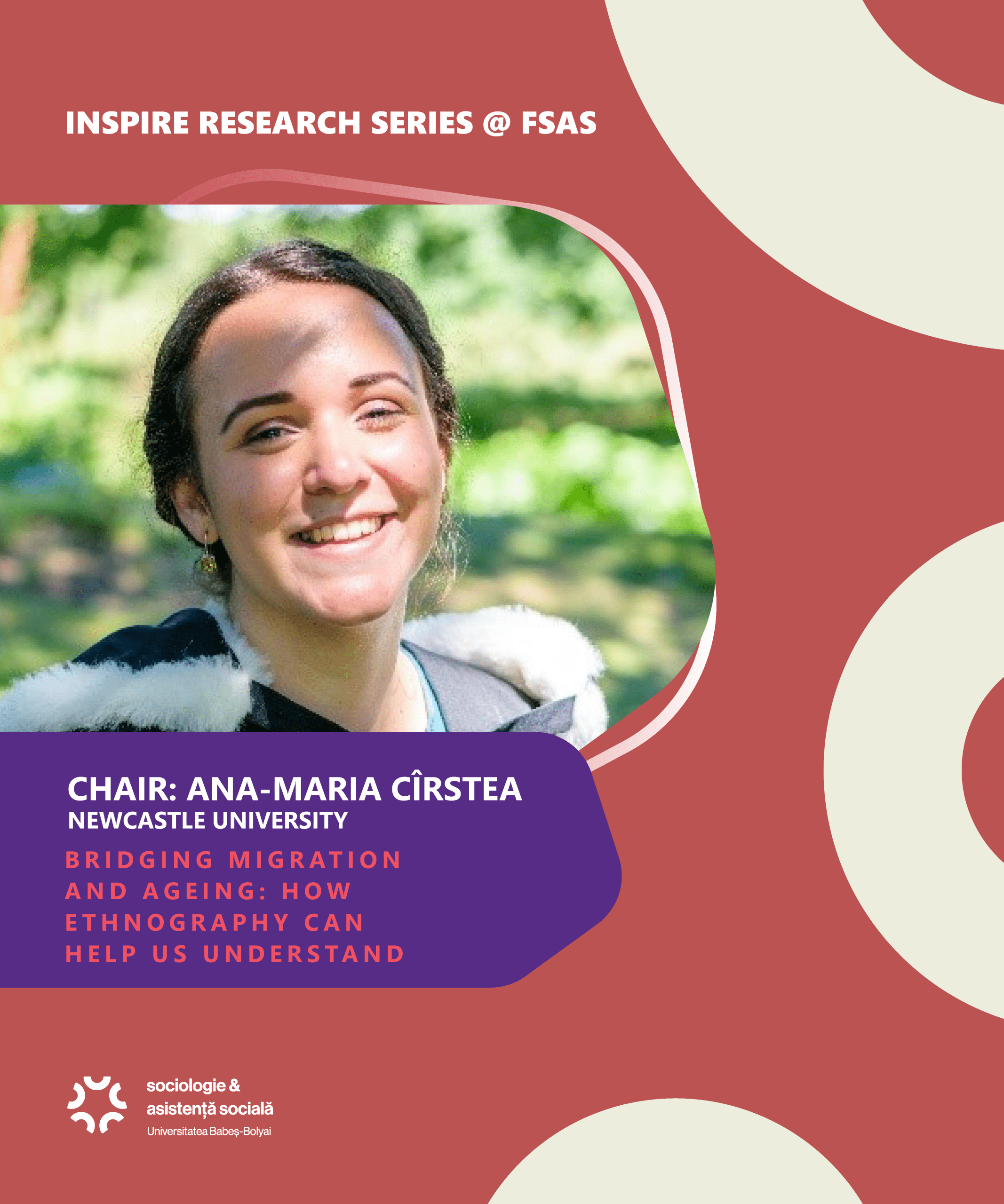
Inspire Research Series @ FSAS
Bridging Migration and Ageing: How Ethnography Can Help Us Understand Societal Challenges
Chair: Ana-Maria Cîrstea
📅 Monday, May 11, 2026
🕚 12:00 – 13:30
📍 Room: 217, second floor
Presentation Overview
What connects Sri Lankan villages to care homes in rural Transylvania? What links the plains of Lahore to life in post-industrial Britain? Which methodological and epistemological approaches are best suited to understanding these contested global connections?
This presentation draws on three research projects—focused on migration, ageing, and their interconnections—to reflect on key ethnographic principles. It begins by examining the process of making the strange familiar and the familiar strange, while inviting the audience to reflect on their own positionalities and the bonds they build with those they seek to understand. It then considers how both our surroundings and our participants actively shape fieldwork experiences. Through these reflections, the paper highlights the potential of ethnographic research to deepen our understanding of societal challenges. It argues that ethnographic approaches may help foster more compassionate worldviews that move beyond simple binaries in an increasingly polarised world.
Who Is This Lecture For?
This lecture is intended for faculty members, researchers, doctoral candidates, and students interested in:
· ethnography and qualitative research methods
· migration, ageing, and their intersections
· researcher positionality and relationships with participants
· methodological and epistemological dimensions of social research
· critical understandings of global connections and contemporary societal challenges
Author Bio
Ana-Maria Cîrstea (Newcastle University, UK) is a social anthropologist interested in the intersections of care, ethnicity, and migration. She is currently exploring how South Asian families live with dementia in the North of England. Her doctoral research at Durham University examined Romanian migration in London. In the future, Ana-Maria hopes to explore the connections between migration and ageing in Central and Eastern Europe.
Inspire Research Series @ FSAS
At FSAS, we believe that research becomes stronger when ideas and people meet. Inspire Research Series @ FSAS was created as a space for dialogue, reflection, and inspiration, at the intersection of departments, study lines, and generations of researchers, but also as a framework in which research is understood not only as a final performance, but as a living practice that concerns each of us in our identity as academic staff.
Through lectures, discussions, and workshops delivered by distinguished invited speakers – from Romania and from abroad – this series aims to make us more aware of the ways in which we think, write, and share knowledge. It invites us to take a step back – or perhaps sideways – in order to set ourselves in motion within a space of critically examining our own ways of doing research, of deconstructing expectations related to performance, productivity, and “outcomes,” and of reactivating the seeker within us (of data, of meaning), the resilient form of the active researcher. It is an invitation to allow ourselves to be inspired and transformed by the diversity of ways of doing, imagining, and living research – with all its challenges, uncertainties, and satisfactions.
Whether it is about publishing in international journals, about academic writing as a process of thinking, about the ethics and politics of knowledge production, about creative and interdisciplinary methods, about slow research, deep work, social impact and public sociology, about research projects that are desired, ongoing, or only just imaginable, about diverse and pressing themes, or about the ways in which artificial intelligence is transforming academic work, Inspire Research Series aims to create connections and to activate thought. Beyond disciplines, beyond borders, beyond different ways of relating to research, and beyond our own academic trajectories.
